In April 2025, the construction began on a modern fibre-optic network in Malá Strana that will bring high-speed internet to households and businesses, along with new pavements and improved public spaces. Everything is taking place under the supervision of Prague 1, with an emphasis on safety, tidiness and clear communication with the public.
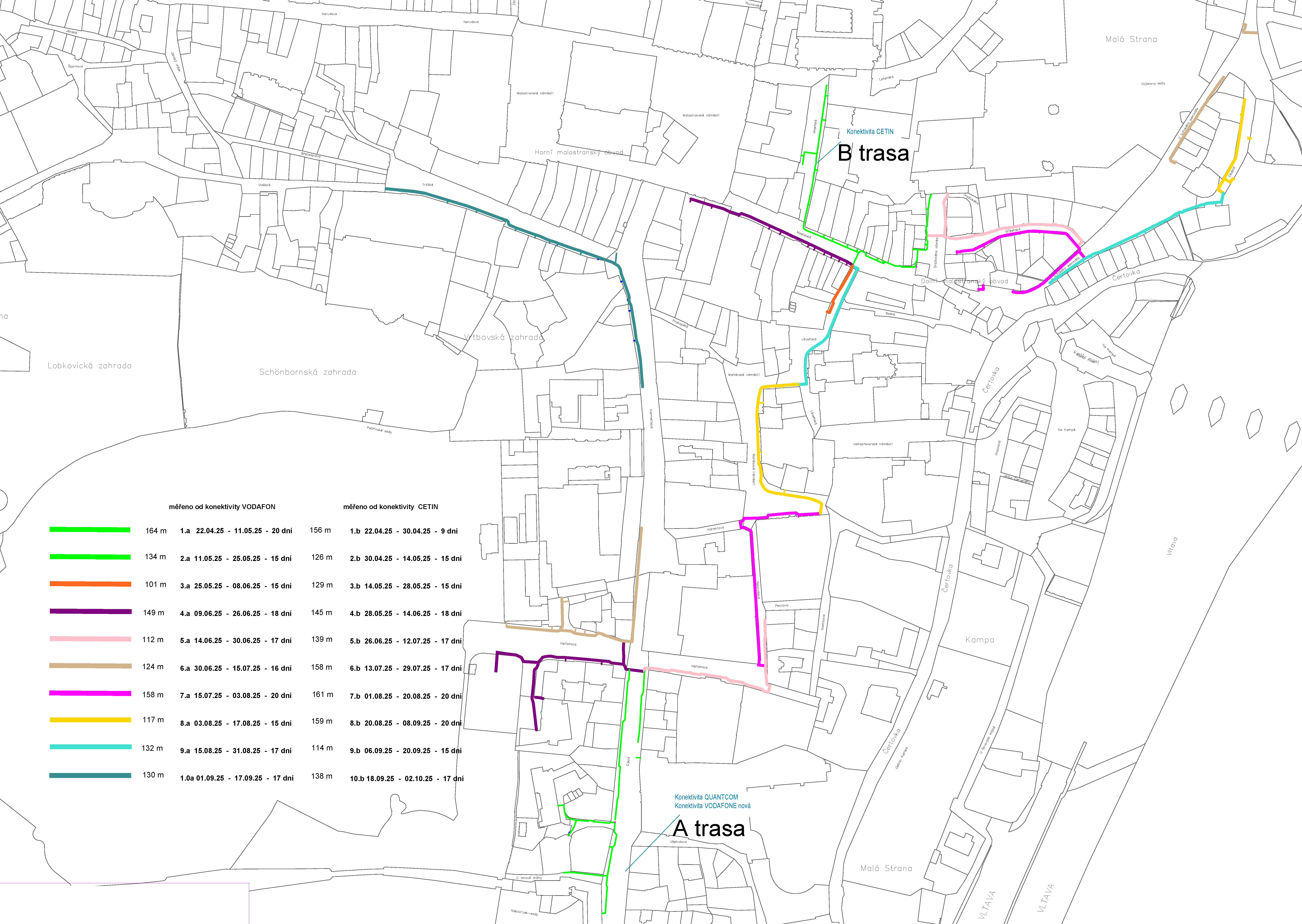
On Tuesday, 22 April 2025, the first stage of a large-scale project to build a fibre-optic network in Malá Strana began. The project is being implemented gradually between 2025 and 2027, and will bring high-speed, stable internet with speeds of up to 10 Gb/s to residents, schools, institutions and businesses.
The project is being executed by Vodafone, Quantcom and CETIN in cooperation with the Prague 1 district and Technická správa komunikací hl. m. Prahy (Technical Administration of Roads of the Capital City of Prague) (TSK).
This coordination means that the trench strip will not only be repaved, but the pavements will undergo complete reconstruction - from façade to curb - including accessibility improvements in locations approved by heritage authorities.
Main benefits for citizens:
· High-speed internet for homes, businesses, schools and institutions
· Reliable, uninterrupted connectivity with strong interference resistance
· High capacity - ideal for working from home, online learning and streaming
· High-speed data uploads - e.g. for video calls and cloud storage
· Higher reliability at peak times and in densely populated areas
Construction work description
The work mainly concerns the pavements, which are being dismantled across their full width to allow for complete surface renewal and accessibility improvements.

Once the mosaic paving is taken up, the pavement is made safe for pedestrian use.
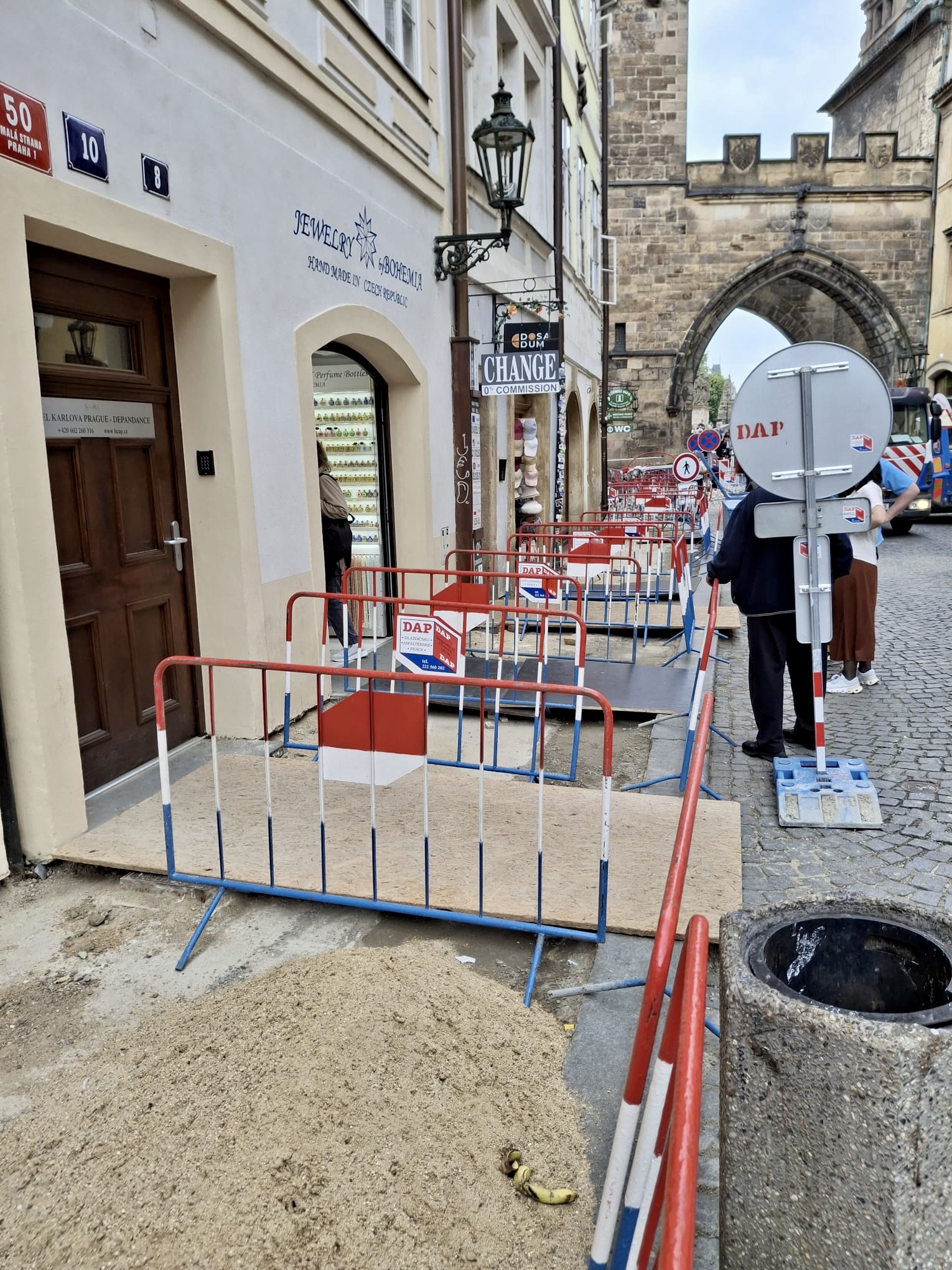
A trench for the optical conduit is opened and covered with walk-on plates, with barriers installed for safety.
The service connections to buildings are covered with access ramps.
After the cables are laid, the trench is backfilled and compacted, and then handed over to the company DAP for pavement restoration.
Where road surfaces need to be opened, the work is kept to a minimum and generally finished the same day.
Construction work progress
At least seven days before work starts, traffic signs are put in place in the affected area.
On the day work begins, all signage is installed in accordance with the approved traffic‑engineering plan (DIR), and dismantling of the mosaic paving commences. The paving is then professionally stored by DAP.
Due to the complete reconstruction of the pavement from the building façade to the curb, the paving is removed across the full width.
The pavements remain accessible to pedestrians for the duration of the work. All trenches are covered with walk-on plates and fitted with barriers.
During the excavation phase, a trench is opened along the curb for the optical cables, and connection pits to individual buildings are dug at the same time. As soon as each is completed, it is covered with a pedestrian walkway.
After the optical cables are installed according to the project, the trench is backfilled and compacted.
The site is then handed over to DAP, which completes the concrete bedding and prepares the base for the new paving.
Next, sand is placed and the new mosaic paving installed across the full width of the pavement.
If necessary, a cable chamber is constructed, again securely covered.
Any opening of road surfaces is time-limited (max. 1 day), marked with traffic signs, and managed as temporary drive‑overs to keep traffic moving smoothly.
Safety and cleaning
Each site is inspected, secured and tidied on an ongoing daily basis.
Updates to routes are regularly published in PACMAN, with affected parties being informed.